
Veterinary Clinics Lose $50,000+ a Year to Missed Phone Calls - Here’s the Fix
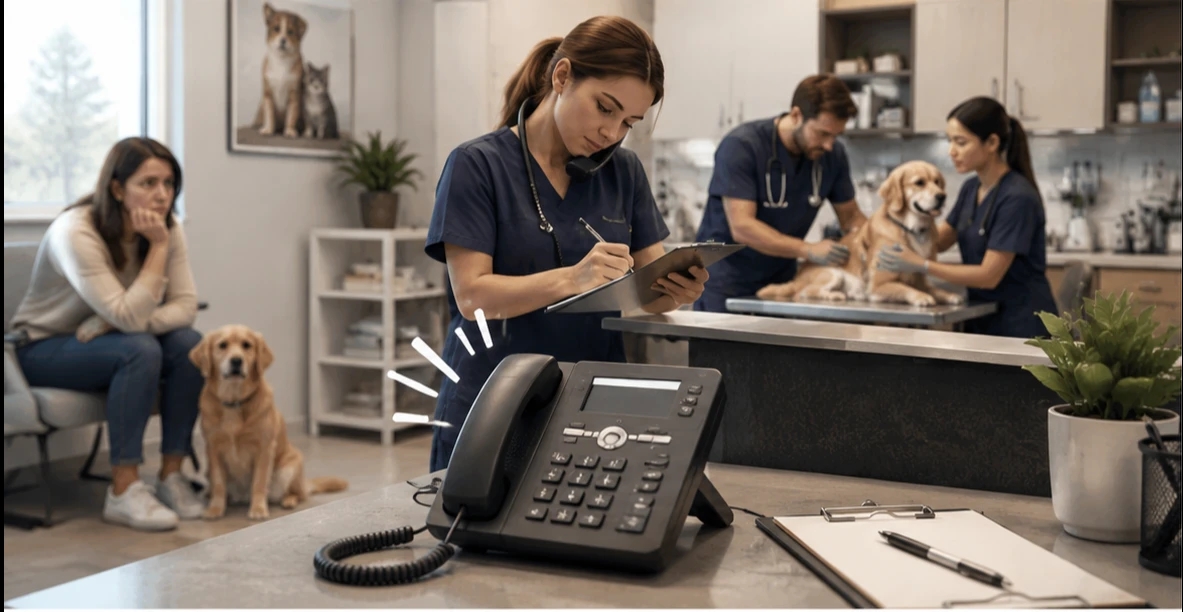
Every unanswered ring at your front desk is a client hanging up, opening a new tab, and booking with the clinic down the road and most vet hospital owners have no idea it's happening until the revenue is already gone.
That single sentence describes a problem playing out in exam rooms and reception areas across the country, several times a day, in almost total silence. There's no alarm that goes off when a call goes unanswered. No dashboard alert. Just a dial tone, a frustrated pet owner, and a booking that never makes it onto your schedule. Multiply that by the number of calls your clinic misses every week, and you get a number most practice owners aren't ready to see: $50,000 or more in lost annual revenue, from a problem that has nothing to do with the quality of your medicine.
This is the most under-diagnosed leak in veterinary practice management and it's entirely fixable. Below, we break down exactly how much missed calls are costing you, why it's happening even at well-run clinics, and the specific systems (including where technology like an AI receptionist fits in) that stop the bleeding for good.
How Many Phone Calls Does a Vet Clinic Miss Per Day?
The honest answer: more than you think, and more than your front desk staff will ever admit.
Front desk teams at veterinary clinics are juggling an enormous amount simultaneously checking patients in, processing payments, comforting anxious pet parents, managing walk-ins, and coordinating with technicians and doctors mid-appointment. The phone is often the fourth or fifth priority in any given moment, not the first.
Industry benchmarking and internal call-tracking data from veterinary hospitals consistently point to a pattern:
Industry data indicates the average small-to-mid-sized veterinary clinic misses between 15–30% of inbound calls during peak hours.
For a clinic receiving 60–100 calls a day, that can mean 10 to 25 missed calls daily, most of them concentrated in the exact windows when your team is busiest: opening rush, lunch coverage gaps, and the last hour before closing.
Why the Miss Rate is So High
- Understaffed front desks. Many clinics run reception with one or two people covering phones, check-in, check-out, and payment processing simultaneously.
- Peak-hour bottlenecks. Mornings (drop-offs) and early evenings (pickups + emergencies) generate call spikes that overwhelm a two-line phone system.
- After-hours silence. Calls placed outside business hours including from pet owners in genuine distress often go to a generic voicemail or nowhere at all.
- Call abandonment during hold. Even calls that are technically "answered" get lost when a client is placed on hold for 10 minutes and hangs up before anyone returns.
If you've never run a call report, assume your clinic is missing more calls than your team believes because no one is tracking the calls that never got picked up in the first place.
What is the Cost of a Missed Call for a Veterinary Clinic?
This is the number that should keep every practice owner up at night, and it's simpler to calculate than most people assume.
The Basic Missed-Call Math
Here's a conservative framework you can run with your own clinic's numbers:
- Average missed calls per day: e.g., 12
- Percentage of callers who are new or booking-ready clients: Industry estimates suggest a meaningful share of inbound veterinary calls are appointment requests, not administrative questions
- Average client lifetime value (LTV): For veterinary medicine, this is not a single visit; it's the multi-year relationship, including wellness visits, dental cleanings, diagnostics, and emergency care
- Conversion rate if the call had been answered
Example calculation; 12 missed calls/day x 30% are new-client booking calls x 250 working days x average new-client first-year value = estimated annual revenue loss
Run this math conservatively and most clinics land well past $50,000 per year and that's before accounting for existing clients who couldn't reach you for a refill, a callback, or a follow-up, and simply switched providers out of frustration.
It's Not Just New Clients You're Losing
A missed call doesn't just cost you one appointment. It costs you:
- The client's full lifetime value: the average veterinary client stays with a practice for years and generates recurring revenue through wellness plans, vaccinations, dentals, and unexpected illness or injury visits.
- Referral value: happy clients refer friends and family; a client who couldn't get through never becomes a referral source.
- Online reputation: frustrated callers increasingly vent on Google reviews, which affects your ability to attract future clients who never even called.
- Emergency-case risk: when a call about a sick or injured pet goes unanswered, the cost isn't just financial. It's a trust failure at the worst possible moment for that client.
Bottom line; a missed call is never just "one call." It's a lost client relationship worth thousands of dollars over time and the interest compounds every year you don't fix it.
Front Desk Staff Are Overwhelmed And It's Not Their Fault
It's tempting to treat this as a staffing performance issue. It almost never is.
Veterinary front desk staff are frequently the highest-stress, most multitasked role in the entire practice, and they're being asked to do something structurally difficult: be fully present for the client in front of them while also being fully available for the client on the phone. Those two things are in direct conflict, and the phone loses almost every time because the client physically standing at the counter feels more urgent than the one who might call back.
The Real Root Causes
- No dedicated call coverage. Most clinics don't have a role whose only job is answering the phone; it's bolted onto reception, tech, or even DVM responsibilities.
- No call overflow system. When every line is busy, callers hit a busy signal or endless ringing instead of a graceful overflow (like a queue, callback offer, or answering service).
- No after-hours or lunch coverage plan. Gaps in coverage are treated as unavoidable instead of solvable.
- No visibility into the problem. Without call tracking or reporting, owners are managing this issue blind you can't fix what you can't measure.
This isn't a training problem. It's a systems and staffing-design problem, and it requires a systems-and-staffing-design solution, not just asking your team to "answer faster."
Voicemail isn't a Real Answer for Veterinary Clients
Veterinary calls carry an emotional weight that most other service businesses never have to account for. When someone calls a plumber or an electrician, they're mildly inconvenienced. When someone calls a vet, they're frequently frightened, anxious, or grieving because the "customer" on the other end of the line is worried about a family member.
That emotional context is exactly why a standard voicemail greeting fails so badly in this industry. A generic "please leave a message and we'll get back to you" recording is not built for a pet owner whose dog just got into a box of chocolate. That caller isn't looking to leave a note for later. They need an answer now: Is this a real emergency? Do I need to go to the ER? Can someone see us today? A voicemail box can't reassure a panicked client, and most won't wait around to find out if anyone calls back.
The numbers make the pattern impossible to ignore: roughly 80% of callers hang up rather than leave a voicemail meaning only about 1 in 5 missed calls even leaves you a message to work with.
The other four simply move on to the next clinic in their search results. This is especially true during the exact windows when clinics are least equipped to catch up Monday morning rushes, lunchtime coverage gaps, and the after-school stretch when call volume spikes but staffing doesn't. In those moments, an in-person client at the counter will always outrank a ringing phone, and it's the caller, often the one who needs you most urgently, who quietly disappears.
How Can Veterinary Clinics Stop Missing Phone Calls? (7 Proven Fixes)
The good news: this is one of the most solvable problems in practice management, because the fixes are well-established and don't require you to compromise on patient care to implement them.
1. Get a Real Picture of the Problem First
Before fixing anything, measure it. Most veterinary practice management software and modern phone systems can generate call reports showing:
- Total inbound calls
- Missed vs. answered calls
- Average hold time before abandonment
- Peak missed-call windows
You cannot prioritize this fix internally or justify the investment in a solution without a baseline number.
2. Implement Dedicated Vet Clinic Call Volume Management
Rather than treating phone coverage as an afterthought, structure it as its own function:
- Designate call-coverage shifts, especially during known peak windows (opening, lunch, closing)
- Build a rotation so no single team member is a single point of failure
- Set clear scripts and hold-time protocols so no caller sits in silence for more than a few seconds
3. Deploy an AI Receptionist Built for Vet Clinics
This is the single highest-leverage fix available to clinics today, and it's rapidly becoming the standard that traditional phone answering services are being measured against.
A traditional veterinary phone answering service solves part of the problem a human catches your overflow calls but it comes with its own limits: staffing costs, inconsistent training on your specific clinic's protocols, and generalist agents who may not know your appointment types, your doctors' schedules, or your triage preferences.
An AI receptionist built specifically for veterinary clinics closes that gap. Instead of a generic answering service reading from a script, it's trained on veterinary-specific workflows from the start appointment types, common client questions, and basic triage logic and it never has a bad shift, a lunch break, or a busy signal.
What an AI receptionist for vet clinics can do:
- Answer every call instantly, 24/7 no hold time, no busy signal, no missed windows
- Speak in your clinic's name and tone, so callers never feel like they've reached a call center
- Book, reschedule, and confirm appointments directly into your practice management software in real time
- Ask the right triage questions to flag true emergencies for immediate human hand-off
- Answer routine questions (hours, pricing ranges, what to bring to a visit) instantly, freeing your front desk for in-clinic clients
- Scale infinitely during peak call windows it never gets overwhelmed by a Monday-morning rush the way a one- or two-person front desk does
Why this matters more than a standard answering service: The cost of a human overflow service scales with your call volume and staffing hours. An AI receptionist can absorb an unlimited number of simultaneous calls at a fraction of the cost of adding headcount, while still handing off anything urgent or complex to your team. For most clinics, this is the fastest way to close the missed-call gap identified earlier in this article without hiring a single additional employee.
4. Fix Your After-Hours Coverage
Pet emergencies don't respect business hours. At minimum, every clinic needs:
- A clear after-hours message directing true emergencies to the nearest emergency hospital
- A system to capture non-emergency after-hours calls (many of which are booking requests) instead of losing them entirely.
This is another area where an AI receptionist closes a gap that human staffing simply can't cover affordably. No clinic can justify paying a person to sit by the phone at 2am but an AI receptionist is already working then, answering every after-hours call in your clinic's name, correctly triaging genuine emergencies to the right emergency hospital, and capturing every non-urgent booking request that would otherwise go to voicemail and never get returned.
The result: your after-hours coverage stops being a liability gap and becomes another channel that quietly books appointments while your clinic is closed.
5. Invest in Veterinary Practice Management Software With Integrated Communication Tools
Modern veterinary practice management software increasingly includes (or integrates with) call tracking, automated appointment reminders, two-way texting, and online booking all of which reduce the volume of calls your front desk has to field manually, freeing them to focus on the calls that truly need a human.
6. Add Self-Service Booking Options
Not every client wants to call. Online appointment requests, text-to-book, and a well-maintained FAQ page reduce inbound call volume for routine requests (refills, wellness visit scheduling, basic questions), leaving your phone lines freer for higher-priority calls.
7. Build a Client Retention Strategy Around Communication, Not Just Medicine
The clinics that retain clients longest treat communication access as part of the care experience, not an administrative afterthought. Strong veterinary client retention strategies include:
- Proactive follow-up calls/texts after major visits or diagnoses
- Multiple easy ways to reach the clinic (phone, text, online portal)
- Fast response times as a stated practice value, not just an internal goal
- Regular review of missed-call and response-time data as a standing agenda item in practice meetings
The clinics that stop losing money to missed calls don't rely on a single fix; they combine measurement, staffing structure, technology, and an answering service safety net so no call is ever truly lost.
A Real-World Example: What This Looks Like in Practice
Case study/example "Clinic X, a two-doctor small animal practice seeing approximately 80 calls per day, implemented call tracking and discovered they were missing 18% of inbound calls, concentrated between 8–9am and 5–6pm. After adding a veterinary answering service for overflow coverage and restructuring front desk shifts, missed calls dropped to under 4%, and the clinic booked an estimated 500 additional new-client appointments in the following quarter."
This kind of result isn't unusual once the problem is measured and addressed directly because the demand was never the issue. The access was.
Stop Losing Clients to a Ringing Phone
You didn't get into veterinary medicine to lose clients over hold music. Every missed call is a pet owner who needed you and couldn't reach you and that's a gap worth closing, not living with.
If you want to see exactly how many calls your clinic is missing and what that's actually costing you, MyVetHub's AI Receptionist was built specifically to close that gap answering every call, day or night, in your clinic's voice, so no client and no revenue slips through the cracks again. Explore how MyVetHub's VERA AI Receptionist helps veterinary clinics capture every call, retain more clients, and grow without adding to your front desk's workload.